
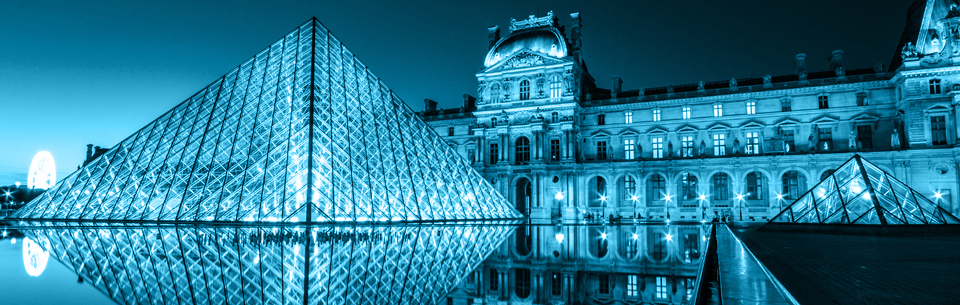
Le Louvre Museum
The Louvre Museum in Paris is the probably the most famous and largest art museum in the world! It has been influenced by major events in French history and has experienced changes and additions to the original structure by many architects and decorators. When the Orsay museum was created in 1986, most of the post 1848 works left the Louvre and were transferred to the new museum which is close by.
The museum presents the main part of its treasures to visitors, in the new Richelieu wing, islamic art collections, oriental antiques, French sculptures, objets d'art,French paintings & paintings from the Northern school (including Rubens).
Let's not forget, Mona Lisa in her new quarters, the Winged Victory and the Venus (actually Aphrodite) de Milo, of course. But choose at least one other superb, and less-crowded, gallery. Egyptian or Roman antiquities, Italian, French or Spanish painting, the Medieval Treasury, the Napoleon III aprtments. Extra: the underground remains of the early XIIIth century Louvre fortress.
The Louvre was built on the site of a medieval fortress on the banks of the Seine river. It was used as the official residence of the French Kings during the 16th and 17th centuries before the Court moved to Versailles in 1682. It officially became a "Peoples Museum" in 1793 after the Revolution, and is now one of the most important museums in the world.
Its collection, which ranges from Egyptian art of 5000 BC to nineteenth-century work, is divided into seven departments: Oriental and Islamic Antiquities; Egyptian Antiquities; Greek, Roman and Etruscan Antiquities; Painting; Sculpture; Decorative Arts; and Graphic Arts.
Throughout the 17th century, as Paris assumed a dominant role in Europe, the Louvre's holdings increased dramatically. Particularly important acquisitions during this period were major works by the great Dutch and Flemish masters. In the 18th century the annual salon exhibitions were established. The first state museum was opened in the Louvre in 1793. The central position held by the Louvre in the artistic life was magnified by Napoleon I, who began its Egyptian collection. The overall museum complex was completed under Napoleon III (1852-70). Subsequently, the Louvre expanded its collections greatly through gifts and bequests. Its departments now include Oriental (ancient Mesopotamian), Greek and Roman, and Egyptian antiquities; sculptures from the Middle Age to modern times; furniture and objets d'art; and European paintings and drawings.
In the late 1980's during the construction of I.M. Pei's pyramids, the original Medieval fortress base was unearthed, quickly incorporated into the design, and is now on display as part of the museum's collection.